 Eurasia Press & News
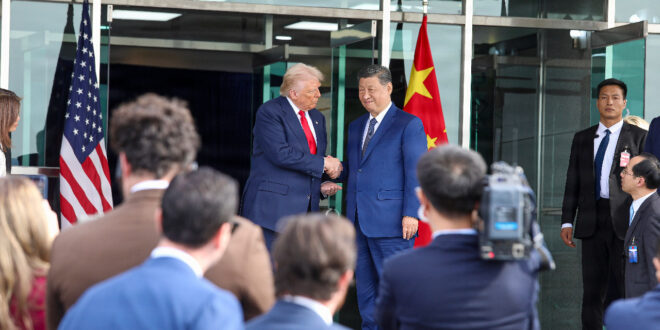
Some commentators have said the meeting between Donald Trump and Xi Jinping will be “insignificant,” but Graham Allison disagrees.
In a world in which President Donald Trump is the producer of a 24/7 reality TV show, on the one hand, and president of the most powerful nation in the real world, on the other, trying to make sense of what is happening is a daily challenge for all of us. Nonetheless, as we look ahead to the summit between Presidents Trump and Xi Jinping in Beijing that begins tonight, I believe that we can predict with some confidence what will happen on the stage. Specifically, I am offering 4 to 1 odds that the summit will be, and will be declared by both leaders to be, a great success. My confidence in offering this bet is based on several judgments: each wants this to be a success; each is prepared to give the other what he needs to declare the summit successful; each has informed the other that he’s prepared to deliver; and the summit managers working for each team have laid the groundwork to ensure success.
Peering deeper into my cloudy crystal ball, I’ll hazard a further bet that this will be remembered as the “business” summit in which economics is elevated to a position of equality with geopolitics and “business statecraft” comes to play a larger role in diplomacy. This is symbolized by the presence of a chorus that includes the richest businessman in the world (Elon Musk), the CEO of the largest asset management company in the world (Larry Fink) and the leaders of two of only four companies in the world to achieve $4 trillion valuations (Apple CEO Tim Cook and NVIDIA CEO Jensen Huang) heralding the mutual benefits of “win-win” business between the two largest economies in the world. If Saturday Night Live were to do a skit on the summit, it might be called “Make Wealth Not War.”
Over the past 16 months since President Xi called President Trump to congratulate him on his reelection, the two leaders have been in regular communication through letters, phone calls, and last October’s meeting in Korea on the sidelines of APEC. Moreover, the designated managers of the summit—Treasury Secretary Scott Bessent and his counterpart, Vice Premier He Lifeng—have established an effective working relationship and reached agreement on the major elements of a “successful” deal that the leaders will ratify and announce. The Trump team’s concept of the summit was foreshadowed last week during a visit by a delegation of senators who declared: “we want to de-escalate, not decouple. We want stability, we want mutual respect.”
For both leaders, the primary objective at the summit will be to strengthen the stability and predictability of relations between the two most powerful nations in the world and create the conditions necessary for each to pursue his own domestic agenda. While Xi has already secured his position as “leader for life,” the choreography of this visit will remind Chinese citizens of imperial receptions of foreign leaders who come to pay respect and recognize China’s greatness. In engaging the erratic and unpredictable leader of the most powerful nation on earth (who has in the past three months ordered his military to kidnap the leader of one nation and helped the Israeli military assassinate the leader and his key associates in a decapitation attack that declared war on a second), demonstrating that he can manage the risks that Trump poses for China comes first in Xi’s mind. Moreover, Xi wants to sustain the current permissive environment in which China can continue its rise to become the world’s leading economy, trading partner, manufacturer, and technology developer. For Trump, facing mid-term elections on November 3 in which Republican defeat in the House and potentially the Senate would constrain his power to pursue his own agenda, a productive relationship with China that fuels a “roaring hot” US economy is a necessity. Moreover, for someone who aspires to be remembered as a great peacemaker, the possibility of a US-China led Pax Pacifica remains alluring.
Therefore, expect the summit to deliver a framework agreement that replaces the one-year truce announced last November and encourages companies to buy, sell, and invest. The two governments are likely to announce the creation of a “Board of Trade” and a “Board of Investment,” as US Trade Representative Jamieson Greer has suggested, to facilitate ongoing conversations on issues such as Chinese FDI in the US. One can be certain that China will agree to buy more soybeans, more beef, more airplanes, and other products sold by members of the business delegation accompanying the president. The US will agree to loosen constraints on the sale of advanced semiconductors. China will announce new measures to prevent the sale and export of fentanyl precursors to the US or even Mexico. The US may signal, rhetorically or materially, a lighter hand on Taiwan. Since President Trump likes headline announcements, I suspect he will declare a Trillion Dollar Great Rebalancing in which China makes time-delimited commitments to buy an additional $1 trillion of American products.
Early coverage of the summit reflects disappointment at the absence of the drama that many have become accustomed to in covering Trump. A number of reporters and commentators have already offered their verdict that the summit will be “insignificant.” I disagree. To explain why, it is necessary to review developments over the past 15 months that have shaped the performance we will see in Beijing. While this is a long article, let me offer highlights in brief answers to eight key questions.
- Can a Conversation Between Trump and Xi Produce Meaningful Outcomes?
A multi-hour face-to-face meeting between the leaders of the two most powerful nations on Earth where they talk privately and candidly about the most important issues on the international agenda including war and peace, trade, tariffs and supply chains, AI, and more cannot be insignificant. Both leaders understand that their nations are locked in a classic Thucydidean rivalry—as a rapidly rising China seriously threatens to displace a colossal ruling US at the top of every pecking order. Both know that such rivalries normally end in catastrophic war. In a lengthy interview with The Economist just six months before his death three years ago, Henry Kissinger was asked about the prospect of a summit meeting between the US and Chinese presidents. He answered: “If the two presidents meet, rather than list all their grievances, which they know… Hopefully the American president, from my point of view, would say: ‘Mr. President, the two greatest dangers to peace right now, are us two. In the sense that we have the capacity to destroy humanity. I think we should agree between ourselves to try to avoid such a situation.’”
Fortunately, both Trump and Xi understand the foundational truth captured in Ronald Reagan’s incandescent one-liner: “A nuclear war cannot be won—and must therefore never be fought.” President Xi has vividly described nuclear weapons as the “Sword of Damocles” that hangs over mankind. President Trump has frequently offered his judgment that “The single greatest problem the world has is nuclear armament, nuclear weapons.” To prevent war between their two nations requires limiting the misperceptions, misunderstandings, and miscalculations that have caused so many previous Thucydidean rivalries to end in catastrophic war.
In the current rivalry between China and the US, the most dangerous flashpoint is Taiwan. Whether the leaders will make any public statement about Taiwan remains uncertain—though it’s quite possible that President Trump may offer a modest concession in stating that the US “opposes,” instead of the current language that the US “does not support,” Taiwanese independence. Much more important, however, will be their affirmation of the agreement they have discussed at length in earlier private communications in which they have expressed their mutual determination not to allow provocations by a third party, including Taiwanese independence advocates, to drag their two great nations into a war neither wants.
- Why Does Trump Consistently Treat Xi Differently?
The difference between the way President Trump deals with President Xi, on the one hand, and the way he deals with almost every other leader in the world, on the other, is hard to ignore. A leader who likes being recognized as the “great disruptor,” using unpredictability to create discomfort in negotiations with most other leaders, behaves quite differently in relations with Xi.
To quote the journalist Bill O’Reilly (who has known Trump for more than three decades), Trump is a combination of “Dr. Jekyll and Mr. Hyde”— and one can never be sure which shows up on any given day. In Beijing, expect Dr. Jekyll: a cautious, careful, sensitive leader engaging another leader whom he has repeatedly said he respects as a “leader of extraordinary distinction,” admires, and that he wishes he could emulate in many arenas.
Why the difference? In my assessment, it is because President Trump recognizes, as he publicly acknowledges, that China is essentially America’s peer competitor. It is a country with which we are so entangled economically that each has so much capacity to cause damage to the other that an economic war cannot be won. He also sees a huge economy across the Pacific with a massive underconsumption problem, offering the prospect of huge markets and profits for American businesses if handled properly.
- Why in Confrontations with Xi Does Trump Always Chicken Out?
Trump Always Chickens Out (TACO) is an acronym coined by a Financial Times journalist to describe Trump’s behavior in confrontations with Xi. The most dramatic example occurred last spring after Trump had attempted to bully China by waving his magic tariff wand. A series of tit for tat escalations left the US imposing 145% tariffs on goods from China—which Treasury Secretary Bessent called an “embargo.” Why did Trump then back down so rapidly and visibly that it was called TACO? Because China responded by squeezing supply chains of critical items, including the rare earth magnets necessary for manufacturing domestically products ranging from Ford Explorers to F-35s to Patriot interceptors.
President Trump has been nothing if not candid in explaining how he sees America’s predicament. As he responded to questions from Fox News: “If you don’t have a magnet, you don’t make a car, you don’t make a computer, you don’t make televisions and radios and all the other things. You don’t make anything. It’s a 30-year effort to monopolize a very important thing.” His Treasury Secretary agreed, insisting that the imperative now must be to “get out from under this sword the Chinese have over us—and they have it over the whole world.”
- Is Trump Being Too Soft on China?
President Trump’s critics both on the right (like the editorial page of the Wall Street Journal) and the left (like The New York Times) continue warning that Trump has become too “accommodationist” or “concessional.” They call on Trump to stand up, push back harder, and be tougher in insisting that China back down. What does Trump know that they don’t? He would say (and I agree) that he inherited a weak hand, especially in supply chain vulnerabilities; that Xi knows that Trump knows; that Trump knows that Xi knows that he knows. And that as a result for today and for as far ahead as Trump can see, the US and Chinese economies are entangled in a relationship that is the economic equivalent of mutual assured destruction (MAD). Nuclear MAD describes a condition in which two states have robust nuclear arsenals capable of withstanding a first strike by the other and retaliating in a way that destroys the attacker. The economic equivalent, sometimes described as MAED, mutual assured economic disruption, describes a reality where two parties have the capacity to cause so much damage to the other that they are deterred from fighting an economic war in the first place.
Last year, President Trump and his team made the mistake of choosing a course of action when imposing extreme tariffs without thinking carefully about how China would respond. As he has told colleagues, it is not a mistake he plans to repeat. Now when considering actions he pauses to ask: “What could China do in response?” As he says: “It’s a big chess game at a very high level. It’s very high-level chess, the highest, and I’m dealing with very smart players.”
- Does Trump Have a Coherent Strategy for US Relations with China?
Coherent strategy is not a concept many associate with the Trump administration. As most commentary on his war with Iran has noted, the administration is long on tactics (like bombing targets) and short on strategy (which requires an alignment of means to desired ends.) Is Trump’s China policy different?
Reviewing what Trump has said and done since his campaign in 2024, it is not difficult to make the argument for the affirmative. During the campaign, Trump demonstrated that he is not a China hawk, repeatedly telling skeptical voters that he “admires” China, that he “loves China,” and that he especially admires Xi Jinping. In a series of phone calls, letters, and meetings with President Xi, he has consistently communicated not just respect, but an eagerness to find ways to cooperate. It was not by accident that the Trump administration’s National Security Strategy and National Defense Strategy omitted the concept that had been the focal point for the previous three administrations: “great power competition.” President Trump actually tried to persuade President Xi to come as his special guest to his inauguration. And when that was not successful, he proposed that they have an early meeting in which he would travel to Beijing, and that Xi would reciprocate by coming to the US later in the year. He expressed his hope that they might see each other as well on the sidelines of two further meetings, APEC and G20, at which both are likely to be present. The plan for as many as four meetings over the course of 2026 in order to ensure “head-of-state diplomacy” is hardly accidental.
In addition, while parts of the US government have continued taking actions that punish China for offenses or disadvantage China in certain arenas, President Trump’s White House has exercised more discipline in constraining these actions than in any other arena. For instance, while some will point to Trump’s signature on the largest arms package to Taiwan ever, in an apparently unintentional aside when asked earlier this week about US arms sales to Taiwan, President Trump said: “Well, I’m going to have that discussion with President Xi. President Xi would like us not to and I’ll have that discussion. That’s one of the many things I’ll be talking about.” In sum, while it requires a bit of a stretch, I think that there’s sufficient evidence to suggest that there is an alignment of activities to a desired objective to create a qualitatively different relationship with China.
- What is “Business Statecraft” or “Business Diplomacy?”
Seeing US-China relations through a business lens means analyzing relations between the two countries as one would assess relations between companies that are simultaneously fierce rivals and friendly partners. They are forced by circumstances to find ways to simultaneously compete and cooperate. For clues, consider what some of the business champions accompanying Trump on this trip to Beijing have said.
Elon Musk (Tesla, SpaceX): “Both the US and China are extremely dependent on each other. The interests of the United States and China are interlinked like conjoined twins, inseparable from each other.”
Larry Fink (BlackRock): “My view is that we will have a strong relationship with China in one form or another.”
Jensen Huang (Nvidia): “China is our competitor, not our enemy. And the reason for that is because we have deepened our connections and interdependencies…. I welcome competition. Competitors come on, let’s go play. That’s the American spirit.”
Tim Cook (Apple): “As you know, we’ve been in China for more than 30 years. While there are clearly companies who have been in China longer, I don’t think any of them have produced such a win-win relationship.”- What Does This Summit Suggest for Future US Policy Towards China?
In essence, both presidents are responding to Henry Kissinger’s challenge when in his final years he argued that both nations needed a new “strategic concept” comprehensive enough to include the necessity to compete, on the one hand, and the imperative to cooperate, on the other. That insight that emerged during the Cold War was summarized by Kissinger in a 1974 statement: “Major nuclear powers must base their policies on the premise that neither can expect to impose its will on the other without running an intolerable risk. The challenge of our time is to reconcile the reality of competition with the imperative of coexistence.”
President Xi discussed this challenge with Kissinger and has subsequently expressed his view on a number of occasions, stating to a delegation of congressional and business leaders: “What did I mean when I said the US and China should work towards a relationship where ‘I am in you, you are in me?’ The answer is ‘engagement.’ Through communication and cooperation, the US and China can become closely linked.” Most recently, he evoked the image of a ship co-captained by the US and China, telling Trump, “In the new year, I hope to work with you to steer the giant ship of China-U.S. relations steadily forward through winds and storms, and accomplish more big things and good things.” President Trump has similarly offered several articulations of a new conception, beginning with his repeated claim that “the US and China working together can solve almost any problem.” After his meeting with President Xi last October, in an interview with 60 Minutes, he became more specific: “This is a very competitive world, especially when it comes to China and the U.S. We’re always watching them, and they’re always watching us. In the meantime, I think we get along very well, and I think we can be bigger, better, and stronger by working with them as opposed to just knocking them out.”
- To What End?
Behind the public framing of the US-China relationship, both Xi and Trump realize that structurally, their two nations are destined to be the fiercest rivals in history. Xi’s banner claim is to “make China great again.” He is seriously seeking to make China as great as it can be. From the perspective of Chinese history, this means the greatest nation in the world. President Trump and his team are red, white, and blue America Firsters who believe that the US was, is, and should be the greatest nation on earth. They believe (as do I) that the US was the architect, builder, and guardian of an international order that has allowed Americans and everyone else on Planet Earth to enjoy the longest period without great power war since the Roman Empire and the greatest growth in economic wellbeing in history.
Neither is likely to change his views. However, the formal language describes the relationship between the two nations, each will continue attempting to advance its own vision.
To what end? Taking seriously what each of the leaders has said, could we imagine the next half-century as a Grand Geostrategic Olympics in which each competitor does its best to win as many medals as it can, and each does whatever it can get away with to ensure the rules advantage its team wherever and whenever possible? As each tries to win wherever and however it can, they will both need to be conscious of the risks of missteps that could cause the competition to spiral downwards to an outcome that could be catastrophic for both. As the Olympic motto declares, “stronger, faster, higher—together.”